Listen Better Fast: Notice–Reflect–Invite Practice
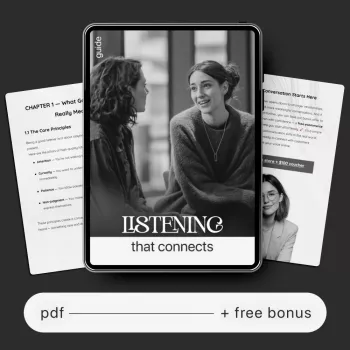
Listening That Connects: a simple practice for better conversations (without feeling scripted)
Some conversations stall because the words are wrong. More often, they stall because the listening is thin—half-attention, rushed replies, problem-solving too soon, or “waiting your turn” while the other person is still trying to land their point. Our team built Listening That Connects for real life: quick check-ins, tense talks, emotional moments, and everyday “can we talk?” conversations.
It’s a digital set that blends an active listening guide eBook, a conversation skills workbook, and an emotional awareness checklist—so listening becomes a repeatable habit, not a personality trait. If you want fewer spirals, fewer misunderstandings, and more “yes, that’s exactly what I meant,” this practice gives you a clear way to get there.
What “connecting listening” looks like in real life
Connecting listening isn’t about staying silent while you mentally prepare your response. It’s what happens when you stay with the speaker long enough to understand their meaning, then confirm you got it right.
- Staying with the speaker’s meaning instead of racing toward a rebuttal or fix
- Reflecting back what you heard so the other person feels accurately understood
- Asking one good question that opens the story, rather than a string of interrogations
- Naming emotions carefully (“It sounds frustrating”) without diagnosing or judging
- Checking what the speaker wants next: to be heard, helped, or simply not alone in it
This approach lines up with established relationship and communication guidance: the American Psychological Association highlights how effective communication supports healthier relationships, and the Gottman Institute emphasizes listening behaviors that reduce defensiveness and build trust.
What’s inside the Listening That Connects digital download
Listening That Connects is designed so you can practice in short bursts—before a hard talk, after a hard talk, or in the “normal conversations” where new habits stick fastest. You can use it on your phone/tablet or print the pages you want to work through.
- Active Listening Guide eBook: a clear, step-by-step approach to listening behaviors that build trust
- Conversation Skills Workbook: practice prompts that turn “good intentions” into usable phrases and routines
- Emotional Awareness Checklist: a fast way to identify what’s happening internally before speaking
- Designed for short practice sessions—use it before a hard talk or after one to review what worked
- Digital format for quick access: save to phone/tablet or print specific pages when needed
Included tools and how they’re used
| Tool | Best time to use it | What it helps prevent |
|---|---|---|
| Active Listening Guide eBook | Before and during important conversations | Interrupting, assuming, debating too early |
| Conversation Skills Workbook | When building a new communication routine | Going blank, using harsh wording, repeating old patterns |
| Emotional Awareness Checklist | Right before responding (especially when triggered) | Defensiveness, tone mismatch, emotional spillover |
The three-step rhythm: Notice → Reflect → Invite
If you’ve ever left a conversation thinking, “That’s not what I meant,” this rhythm is the reset. It’s short enough to use in the moment, and structured enough to keep you from sliding into debate mode too early.
- Notice: pause long enough to catch the speaker’s main point and the emotional temperature in the room
- Reflect: say back the essence in plain language (not a paraphrase contest—an accuracy check)
- Invite: ask one question that helps the speaker go deeper (“What part is hardest?”) or clarifies needs (“Do you want ideas or just listening?”)
- This rhythm reduces misunderstandings because it verifies meaning before solutions
- It also protects the relationship by showing respect even when opinions differ
When you’re not sure what to say, “Reflect” buys you time while still moving the conversation forward. When you’re worried about sounding scripted, “Invite” keeps you curious and human.
When conversations get emotional: use the checklist before the words
In tense moments, your first problem often isn’t wording—it’s your internal state. The emotional awareness checklist helps you slow down by a few seconds, which is often enough to keep the whole interaction from tipping into defensiveness.
- Identify the emotion: angry, embarrassed, anxious, lonely, disappointed—precision helps
- Spot the body signal: tight chest, shallow breath, clenched jaw; it often shows up before the “right” words do
- Name the impulse: fix, defend, withdraw, lecture, prove; labeling the impulse creates choice
- Pick a listening goal: understand, de-escalate, reconnect, or clarify—one goal keeps the talk from spiraling
- Choose a next sentence that fits the goal: short, calm, and grounded in what was heard
Even if the other person is upset, your steadiness can prevent “content drift,” where the conversation stops being about the original issue and becomes about tone, respect, and who’s right.
Practice pages that make listening easier to repeat
How to use Listening That Connects in one week
Recommended downloads from our shop
- Listening That Connects – Active Listening Guide eBook, Conversation Skills Workbook, Emotional Awareness Checklist, Communication Improvement Digital Download
- From Dream to Done: The Ultimate Business Goal-Setting Checklist
- Budget Like a Redditor: Real-Talk, Real Results | Digital Download eBook for Budgeting Help
Who this is for (and when it helps most)
FAQ
Is this focused on listening skills or speaking scripts?
It’s listening-first: attention, reflection, asking better questions, and emotional awareness so you can respond without rushing. You’ll also get practical sentence starters, but they’re meant to support real listening—not lock you into rigid scripts.
Can it help with difficult conversations without escalating them?
Yes—especially through the Notice → Reflect → Invite rhythm, the checklist pause before responding, and simple repair language when you miss the mark. It’s built as a practice tool for de-escalation and clarity, so you can stay connected even when the topic is hard.
Is it printable or only for screens?
It’s a digital download you can use on your phone or tablet for quick reference. If you prefer paper, you can print the specific pages you want to practice or keep nearby.















Leave a comment