Handle Criticism Calmly: Scripts, Boundaries, Confidence

Handling Criticism with Confidence: Calm Responses That Protect Your Peace (and Improve Your Communication)
Criticism can land like a spotlight—sudden, hot, and personal—even when it’s meant to be helpful. The goal isn’t to “toughen up” or win the conversation. The goal is to stay steady, hear what matters, respond with clarity, and keep your self-respect intact. Our team put this guide together to give you a calm, repeatable way to handle criticism in real life—at work, at home, and anywhere feedback shows up—using emotional intelligence and simple communication tools that reduce defensiveness and increase trust.
Why criticism hits so hard (even when it’s not an attack)
Criticism can trigger a threat response: your brain reads disapproval as social danger, which nudges your body toward fight, flight, or freeze. When emotions spike, listening narrows—tone and “what this means about me” can drown out the actual message. If today’s comment resembles earlier unfair judgment or rejection, the moment can feel bigger than it is.
The fastest relief often looks like defensiveness, explaining, or shutting down. Unfortunately, those reactions usually raise the temperature and leave you with the “why did I say that?” hangover later. Confidence under criticism isn’t about being unbothered; it’s about having a plan for what to do next.
Common criticism triggers and the calm reset that works
| Trigger | What it sounds like in your head | Calm reset to use in the moment |
|---|---|---|
| Public feedback | “I’m being embarrassed on purpose.” | Breathe low and slow; ask to continue 1:1: “Can we discuss this after the meeting?” |
| Vague complaints | “They just don’t like me.” | Ask for specifics: “Which part didn’t meet expectations?” |
| Harsh tone | “They’re attacking me.” | Name the goal, not the tone: “I want to understand the concern—can you point to an example?” |
| Unfair or inaccurate criticism | “This is not true, and I need to prove it.” | Pause before correcting; reflect first: “So you’re concerned about X. Here’s what happened on my side.” |
The 30-second calm-down protocol (before saying anything you’ll regret)
When you feel that internal surge, your job is to slow the moment down—just enough to stay in the driver’s seat.
- Pause on purpose: A short delay is a power move, not a weakness. Take a single breath before responding.
- Relax the body to calm the mind: Unclench your jaw, lower your shoulders, and soften your hands. Your body leads your tone.
- Label the feeling silently: “I’m feeling defensive / embarrassed / angry.” Naming the emotion reduces its intensity.
- Choose the outcome you want: Clarity, repair, learning, or boundaries. The outcome tells you what to say next.
- Use a neutral opener: “Thanks for telling me.” This isn’t agreement; it’s a stabilizer.
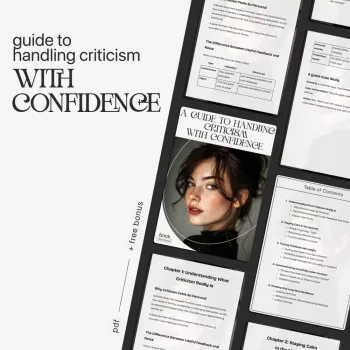
If you want a deeper, step-by-step structure you can practice until it becomes automatic, our team recommends A Guide to Handling Criticism with Confidence (digital download) as a simple, repeatable framework you can keep on your phone or desktop.
A simple script for calm, confident replies (use it anywhere)
When you don’t know what to say, a script prevents spirals. Use this sequence like a checklist:
Calm response templates for common situations
| Situation | Try this response |
|---|---|
| Feedback you agree with | “That’s fair. I see what you mean. I’ll adjust by doing ___.” |
| Feedback you don’t understand | “I want to get this right—can you show me where it missed the mark?” |
| Harsh delivery | “I’m open to the feedback. I can take it in better if we keep it specific.” |
| Untrue claim | “I hear your concern. My understanding is ___. Can we compare details so we’re aligned?” |
| Repeat criticism without guidance | “What would ‘good’ look like to you here? One or two concrete examples would help.” |
Turning criticism into emotional intelligence (without self-abandoning)
For credible, research-informed guidance on feedback conversations, you can also browse Harvard Business Review’s resources on feedback: https://hbr.org/topic/feedback.
When criticism crosses the line: clear boundaries that keep it respectful
If your nervous system stays revved up after tough conversations, the American Psychological Association has practical, evidence-based coping strategies for stress: https://www.apa.org/topics/stress.
Build a personal feedback routine that grows confidence fast
If you want to turn this into a weekly habit, pair your communication practice with planning tools that keep your goals concrete. Our team often uses From Dream to Done: the business goal-setting checklist to translate “I’ll improve” into a real next step you can track.
And if financial stress is part of what makes feedback feel higher-stakes, simplifying your money routine can lower your baseline tension. Two options our customers like are Budget Like a Redditor: Real-Talk, Real Results and Smart Moves: Save Money & Pay Bills Like a Pro.
FAQ
How can criticism stop feeling personal?
Separate identity from behavior by translating vague judgment into specifics you can verify and change. Ask for an example, focus on the action, and use a steady reframe like: “This is information about an action, not a verdict about me.” Self-compassion keeps you open without collapsing into shame.
What should be said when someone criticizes harshly or rudely?
Use a boundary that keeps the door open to useful feedback: “I’m open to the feedback, and I can take it in better if we keep it specific and respectful.” If the tone stays hostile, pause or end it calmly: “I’m going to step away now. We can continue when it’s calmer.”
How can feedback be handled calmly at work without sounding defensive?
Use a workplace-friendly structure: reflect what you heard, clarify with one example, acknowledge impact, and propose a next step. For example: “What I’m hearing is X—can you point to a specific instance? I can see how that affected the team; I’ll do Y going forward.”















Leave a comment